Early Literacy Program
Mountain View Whisman School District
Video of Program
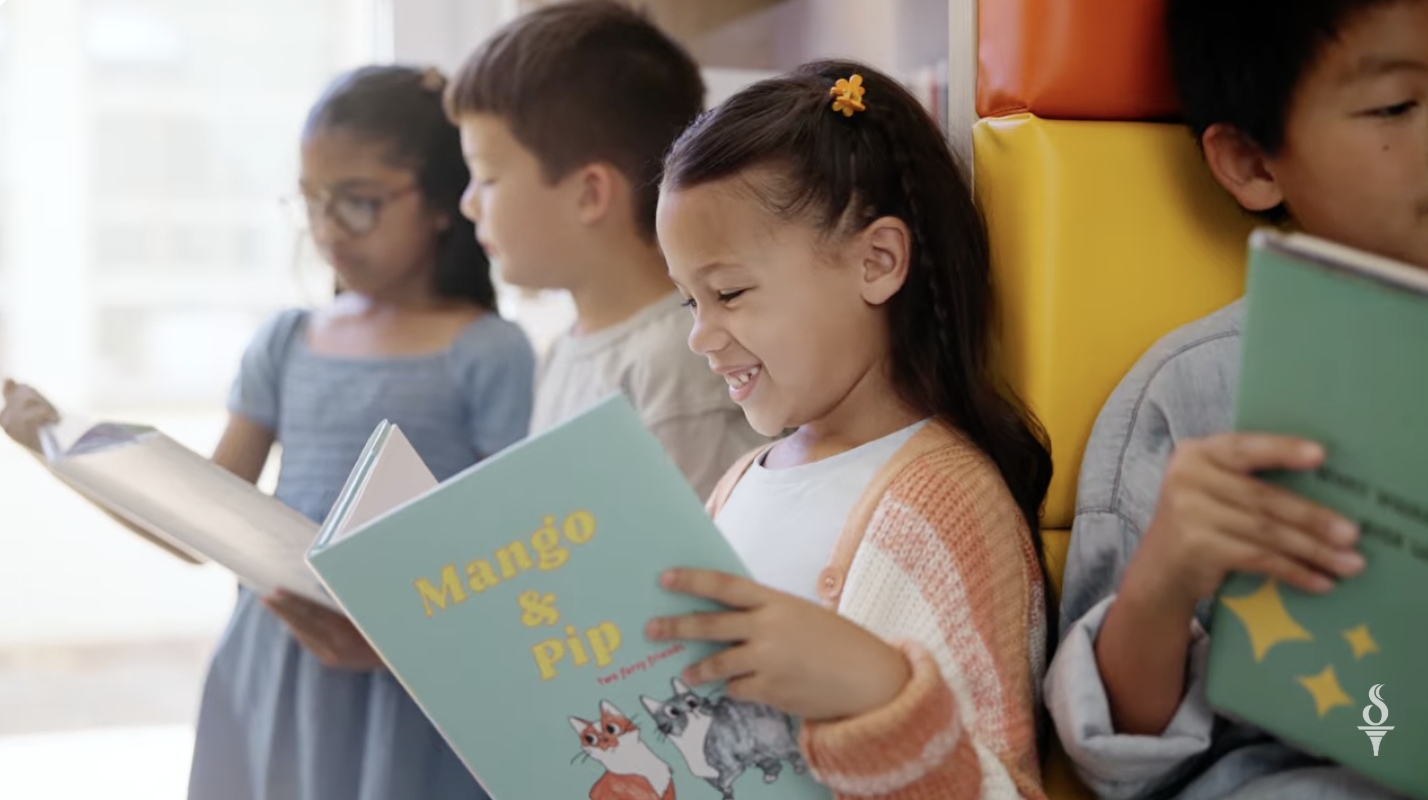
In order to ensure all of our students are reading by third grade, the Mountain View Whisman School District has formed an early literacy team. The team provides targeted reading intervention, and also supports our district’s shift to structured literacy and the Science of Reading through collaboration, professional development, and family literacy events. Our early literacy team consists of 11 site instructional coaches and an additional 6 reading interventionists who are equitably deployed based on student literacy needs.
At our highest needs schools, reading intervention is a team effort. During the multi-grade level intervention period, we leverage our district reading intervention teachers, site instructional coach, special education teacher, and classroom teachers, to regroup students into much smaller, targeted groups. Our reading intervention periods are staggered across school sites so that the district reading interventionists can support multiple school sites each day.
Program Summary
Third grade marks the shift of learning to read to reading to learn. Therefore, it is critical that students are reading at grade level by the time they reach third grade. In Spring 2023, only 67% of our district’s second graders were reading at grade level (Tier 1), according to iReady Reading diagnostic 3. Digging deeper, 14% of our second graders ended the year reading at the Kindergarten level (Tier 3). Proficiency rates were lowest at Castro, Monta Loma, Mistral, and Theuerkauf Elementary Schools--our district schools with the highest percentage of Multilingual Learners and students who are socioeconomically disadvantaged.
Instead of distributing our resources equally across schools, our early literacy team is distributed equitably based on student need. Our higher performing schools have one part time reading intervention teacher serving approximately 15 students, while our higher need schools have multiple interventionists to serve over 70 students.
The Early Literacy Program is directly tied to our district’s LCAP Goal 1 (develop and implement effective and consistent instructional practices that meet the needs of all students), LCAP Goal 6 (develop and implement effective and consistent practices that meet the needs of students of Castro School), and State Priorities 2 (State Standards) and 4 (Pupil Achievement). Castro Elementary is MVWSD’s only Title 1 school with 89% of students identified as unduplicated.
Program Goals
We have seen double digit gains on the i-Ready Reading Diagnostic for students participating in the Early Literacy Program.
In 23-24, the early literacy program served 249 Kindergarten through 2nd grade students at four school sites. Of those students, 70% were socioeconomically disadvantaged (SED) and 68% were multilingual learners (MLL). 43% of students increased at least one tier on the i-Ready Reading Diagnostic (from Diagnostic 1 to Diagnostic 3); 56% of students increased at least one placement level on the phonics subscore.
In 24-25, the early literacy program expanded and served 275 Kindergarten through 5th grade students at five school sites. Of those students, 79% were SED and 76% were MLL. 30% of students increased at least one tier on the i-Ready Reading Diagnostic (from Diagnostic 1 to Diagnostic 3); 46% of K-2 students increased at least one placement level on the phonics subscore.
In 25-26, the early literacy program expanded to serve students at all nine of our elementary school sites--300 Kindergarten through 5th grade students. Of those students, 79% are SED and 77% are MLL.
Impact on Students
In MVWSD, we believe that literacy--the ability to read, write, and comprehend--is a fundamental civil right. We know that learning to read is a gatekeeper to academic success, and that it is our responsibility to ensure that every student leaves MVWSD a skilled reader. We believe in education research and utilize evidence-based practices.
Prior to the Early Literacy Program, we followed a balanced literacy approach. Our data showed that although some of our students were benefitting; the majority of our most marginalized students were not. We knew we needed to change course and could not wait for California’s next curriculum cycle. In 2022, we began to seriously study the Science of Reading, structured literacy, and MTSS.
We now know that reading is not a natural process and must be explicitly taught, skilled reading is the product of increasingly automatic word recognition skills and increasingly strategic language comprehension, and the most effective way to develop skilled readers is through a rigorous, evidence-based core curriculum, paired with screening for reading risk and early, targeted reading intervention.
We know that we do not want to unintentionally create more learning gaps through pull out intervention; therefore, a guiding principle in our Early Literacy Program is that intervention happens during a dedicated period in which every student receives a “second dose” of instruction (intervention or enrichment) and not missing core, first instruction.
Innovation
The Early Literacy Program began in 2023 and is in its third year. It is currently fully funded in our current 2024-2027 LCAP. Early literacy support has been identified as a top priority for classroom teachers, principals, the community, and the Board. The Early Literacy Program is responsive to student and site contexts. In response to the overwhelming support of the Early Literacy Program, we have expanded the program across all of our sites with additional personnel, restructuring our instructional coach role in order to provide even more direct student support. The reading intervention teachers and instructional coaches also provide literacy professional development and ongoing support to our district’s elementary teachers.
Sustainability
The core principles that drive the Early Literacy Program can be replicated at any site or school district:
Dedicate an instructional block during the school day for grade levels, grade level spans, or the entire school to regroup students so that all students can benefit from a “second dose” of instruction in the form of intervention or enrichment.
Develop a team of dedicated early literacy specialists from your existing staff. Our team was trained in the Orton Gillingham methodology. The Santa Clara County of Education has offered an inexpensive OG training program over the last two summers.
Invest in evidence-based, foundational literacy materials aligned with the Science of Reading. The Early Literacy Team uses UFLI Foundations, a highly-validated and inexpensive curriculum from the University of Florida. UF offers free asynchronous professional development, or inexpensive live PD.
Utilize frequent progress monitoring to keep student groups dynamic and responsive. We currently use mCLASS DIBELS to monitor progress every 2 weeks. UCSF Multitudes has also developed evidence-based progress monitoring measures that are free to all California public schools.
Consider centralizing the Early Literacy Team as a district program. Staff can be redeployed to different sites as students’ needs change.
We have created an MVWSD Reading Risk Screener and Early Intervention Guide to support growth at scale.